Apartment Access Control Without the Capital Expense
Most apartment buildings know they need better access control but can't justify the capital expense. Software-first solutions now deliver modern security, visitor screening, and audit logging using your existing intercom hardware.
Knockli Team
Product Team
Building AI-powered access management for modern properties.
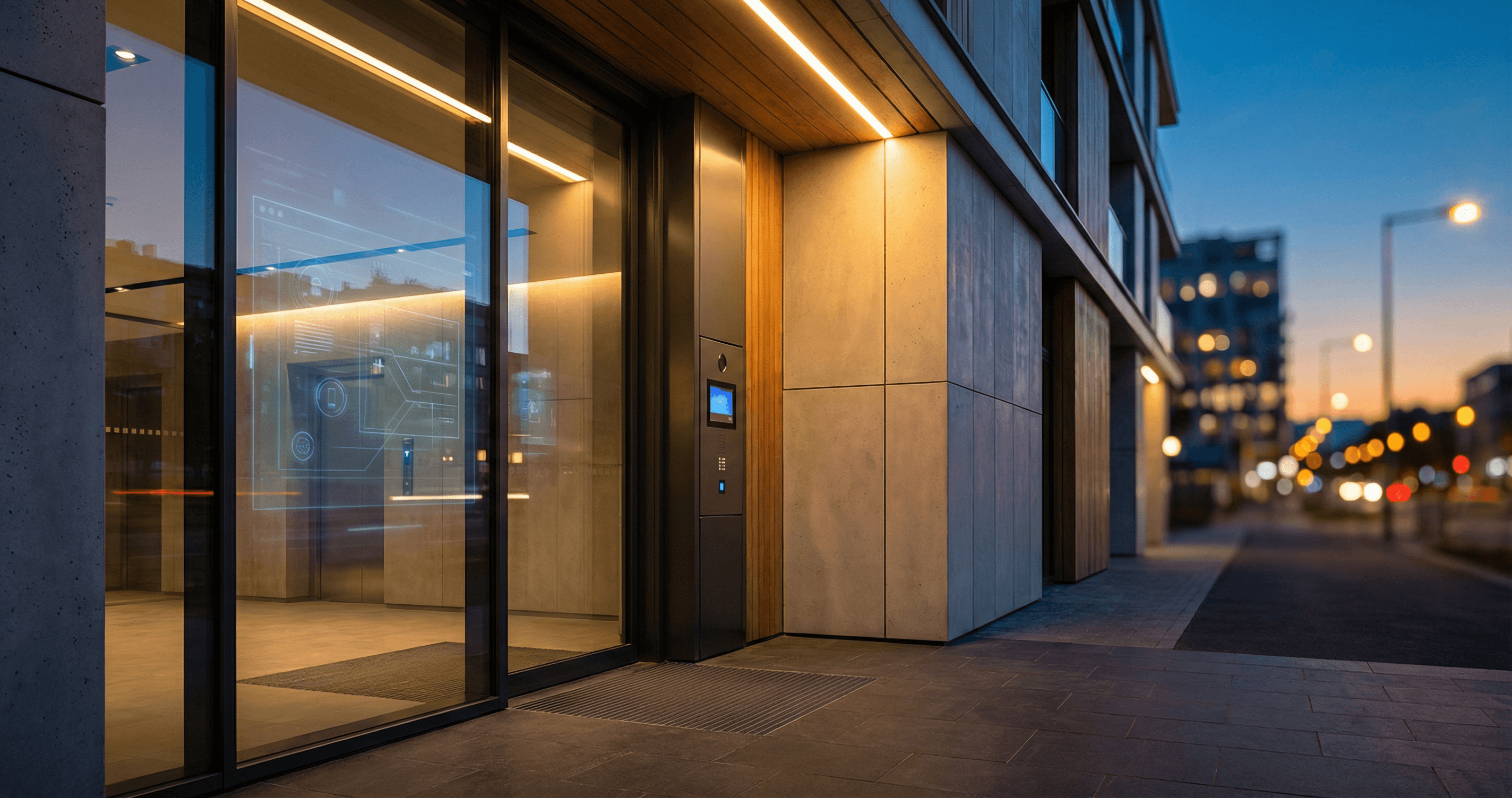
Apartment access control should be straightforward: manage who gets in, when, and under what conditions. In practice, most multifamily properties are stuck between systems that barely work and upgrades they can't afford.
NAA and KeyTrak research found that 76% of multifamily properties still rely on traditional physical keys as their primary access method. Meanwhile, the global access control market reached $10.6 billion in 2025 and is growing at nearly 8% annually. Money is flowing into access control technology, but most apartment buildings aren't seeing any of it.
The disconnect isn't awareness. It's cost. Traditional access control upgrades price out the majority of multifamily portfolios before the first installer shows up. But that's changing.
What Access Control Actually Means for Apartment Buildings
What is access control for apartment buildings? Access control is any system that manages who can enter a building, when they can enter, and under what conditions, replacing ad hoc buzzer decisions with consistent, policy-driven entry management.
In the IT world, access control refers to restricting digital resources. For apartment buildings, the concept is the same but physical: controlling entry to the building, common areas, and individual units.
Effective building access control covers four functions:
- Building visitor management: Verifying visitors, delivery drivers, and service providers before granting access to the property
- Credential management: Issuing, revoking, and tracking keys, fobs, codes, or digital credentials across every unit
- Policy enforcement: Applying consistent rules for who gets in, when, and how (quiet hours, vendor windows, after-hours protocols)
- Audit logging: Recording every access event for compliance, dispute resolution, and security review
Most apartment buildings handle the first function poorly and the other three not at all. A resident presses 9 on their phone, the door opens, and nobody logs anything. That's not access control. That's a liability.
Why Most Access Control Upgrades Stall
Property managers understand the need. Parks Associates reports that over 75% of multifamily decision makers plan to upgrade or replace their electronic access control. So why haven't they?
Three barriers keep building access projects from moving forward:
The capital expense problem. Smart locks run $150-800 per unit for hardware alone, plus $100-400 per unit for installation labor. A 200-unit building faces $50,000-$240,000 before the system processes a single entry. That's a hard budget request when the current system technically works.
The disruption problem. Hardware replacements mean scheduling access to every unit, coordinating with residents, and managing a transition period where old and new systems overlap. For occupied buildings, this can stretch across months.
The integration problem. Many buildings run call boxes from the 1990s and 2000s. New hardware-based systems often require new wiring, network infrastructure, or complete panel replacement. The scope creeps from "upgrade the locks" to "rewire the building."
The credential management problem. Even when buildings do upgrade to fobs or cards, they inherit a new operational burden. Every move-in needs new credentials issued. Every move-out needs old ones deactivated. Lost fobs need replacements at $5-15 each. Multiply that across a portfolio and the ongoing administrative cost rivals the hardware investment itself.
These aren't excuses. They're legitimate operational constraints that have kept the majority of multifamily properties on physical keys while the access control market grew to $10 billion around them.
The average multifamily property spends $2,000-$5,000 annually on rekeying alone, and that's before counting lost fob replacements, lockout calls, and staff time spent managing credentials. Most of these costs are invisible in operating budgets because they're spread across maintenance line items rather than tracked as a single "access" expense.
Apartment Access Control Methods Compared
Not every access control approach requires the same investment. Here's how the five primary methods compare for multifamily properties:
| Method | Upfront Cost | Ongoing Cost | Remote Management | Visitor Screening | Audit Trail |
|---|---|---|---|---|---|
| Physical keys | $30-50/unit | $50/rekey event | None | None | None |
| Key fobs / cards | $200-500/unit + readers | $5-15/fob replacement | Limited | None | Basic |
| Video intercom | $500-2,000/unit | $10-30/unit/month | Yes | Visual only | Yes |
| Mobile access control | $300-800/unit + infrastructure | $5-15/unit/month | Yes | Varies | Yes |
| AI-powered software | $0 hardware | $4-8/unit/month | Yes | Automated | Full |
The first four approaches share a common assumption: access control requires new hardware at the entry point. The fifth category challenges that assumption entirely.
Mobile access control for apartments has gained traction as residents expect phone-based entry, but most mobile systems still require hardware at the door (smart locks, Bluetooth readers, or new panels). The Security Industry Association notes that cloud-based access control for multifamily is shifting the market toward solutions that reduce on-site infrastructure requirements.
Software-first access control takes this further: it works with the intercom infrastructure already in your building. If your call box dials a phone number when a visitor enters a unit code, a software layer can intercept that call, screen the visitor, apply your policies, and log the interaction, all without touching the hardware.
How Software-First Access Control Works
The NMHC's analysis of multifamily access systems notes that traditional credential-based systems are increasingly inadequate for modern building operations. Software-first solutions address this by moving the intelligence from the hardware to the software layer.
Knockli is an example of this approach. Here's how it works in practice:
- Visitor buzzes in. They enter a unit code on your existing call box, just like they do today.
- AI answers the call. Instead of ringing the resident's phone, the call routes to Knockli's AI, which greets the visitor and identifies their purpose through natural conversation.
- Policy engine evaluates. The system checks the visitor against building rules: Is this a recognized delivery service during approved hours? A vendor with a valid passphrase? An unknown visitor during quiet hours?
- Action taken automatically. Verified deliveries get access. Unknown visitors trigger a resident notification. After-hours solicitors get declined. Every interaction is logged.
The setup takes 10-15 minutes per building: forward your call box's phone line to a Knockli number, configure your building-wide policies in natural language, and go live. No wiring. No hardware installation. No resident disruption.
For property managers running multiple buildings, Knockli provides a centralized dashboard for portfolio-wide management. Set policy-driven access rules once and apply them across properties, with building-specific customization where needed.
What makes this different from a simple call-forwarding service is the policy enforcement layer. You're not just routing calls. You're defining who gets in, when, and under what conditions, and the system enforces those rules 24/7 without staff involvement. Delivery drivers from Amazon, FedEx, UPS, and USPS are recognized automatically. Vendor access windows use passphrases and time restrictions. After-hours calls route to on-call staff or get declined per your policy.
The Financial Case for Access Control That Runs on OpEx
The financial argument for software-first access control comes down to a CapEx-to-OpEx conversion.
Traditional hardware upgrades are capital expenditures. They require budget approval, often compete with deferred maintenance priorities, and depreciate on the balance sheet. Software-first solutions are operational expenses, predictable monthly costs that scale with your portfolio.
The numbers support the shift. Buildings Magazine's analysis of multifamily access control found that properties with modern access control report up to 18% increases in net operating income, driven by reduced security staffing costs, fewer key-related maintenance events, and operational efficiency gains.
On the revenue side, Allegion's 2023 Multifamily Living Trends Report found that more than 50% of renters would pay 1-10% more in monthly rent for smart access features. Residents increasingly expect keyless entry in multifamily buildings, and properties that deliver it gain a measurable leasing advantage. For a property charging $1,500/month, that translates to $15-$150 per unit per month in potential rent premium.
Property managers can also offset costs directly through a Tech Service Fee added to lease renewals. At $5-15 per unit per month, a 100-unit building generates $6,000-$18,000 annually while spending a fraction of that on the software.
For a deeper look at quantifying these returns, our guide to building the business case for access technology walks through the full ROI framework.
Compare that to a hardware-first approach:
| Hardware Upgrade | Software-First (Knockli) | |
|---|---|---|
| Upfront cost (200 units) | $50,000-$240,000 | $0 |
| Monthly cost | $10-30/unit | $4-8/unit |
| Setup time | Weeks to months | 10-15 minutes/building |
| Resident disruption | Significant | None |
| ROI timeline | 2-5 years | Immediate |
Software-first access control converts what would be a $50,000-$240,000 capital project into a predictable $4-8 per unit monthly operating expense, removing the primary barrier that has kept 76% of apartment buildings on physical keys. That's not just a pricing difference. It's a fundamentally different budget conversation: one that doesn't require board approval, compete with deferred maintenance, or depreciate on the balance sheet.
What to Consider Before You Start
If you're evaluating access control for your portfolio, three questions will shape your approach:
What infrastructure do you already have? If your buildings use phone-based call boxes (the majority of pre-2015 buildings do), software-first solutions are immediately compatible. If your buildings rely on key-only entry with no intercom, you'll need at minimum a basic call box before layering software on top.
What problems are you actually solving? Access control means different things depending on your adoption starting point. If your primary issue is rekeying costs and lost keys, credential management matters most. If residents complain about missed deliveries and unscreened visitors, building visitor management and policy enforcement are the priority. Software-first solutions tend to address the screening and policy layer first, which is where most resident complaints originate.
How many buildings are in scope? Single-building upgrades can justify hardware investment. Portfolio-wide rollouts almost never can. Software-first approaches scale linearly (add a building in 15 minutes) while hardware approaches scale geometrically (each building requires its own installation project).
What's your residents' biggest complaint? If your top access-related complaints are missed deliveries, unscreened visitors, or after-hours buzzer chaos, those are problems a software layer solves immediately. If the primary complaint is physically broken locks or non-functional intercom hardware, the hardware itself needs attention first. Understanding which layer is broken (physical infrastructure vs. operational intelligence) determines whether you need capital investment, software investment, or both.
Are you ready to enforce policies consistently? The real value of modern access control isn't the technology. It's the consistency. When every visitor interaction follows the same rules regardless of which resident is home, which staff member is on shift, or what time of day it is, complaints drop and liability shrinks. The hardest part of implementation isn't technical. It's deciding what your policies actually are.
The access control market will continue growing, and properties that wait for the "perfect" solution risk falling further behind resident expectations. Starting with a software layer that works today, on the hardware you already have, gets you 80% of the benefit at a fraction of the cost.
Ready to move your building's access control from keys to AI? See how Knockli works for property managers. Setup takes 10-15 minutes per building, requires zero hardware, and the first month is free.
Related Articles
Building Access Rules That Enforce Themselves Without Staff
Most building access rules live in someone's head. Learn how to formalize five critical access policies and automate enforcement without adding staff.
Building Access Upgrades Driven by Lockouts, Not Break-Ins
NAA/KeyTrak research shows zero property managers cited security as a reason for smart access adoption. Lockouts, rekeying, and standardization drive upgrades.
Building Access Technology: Evaluation Framework for Property Managers
A structured framework for evaluating building access solutions. Compare solution types, calculate true TCO, and ask the right vendor questions.